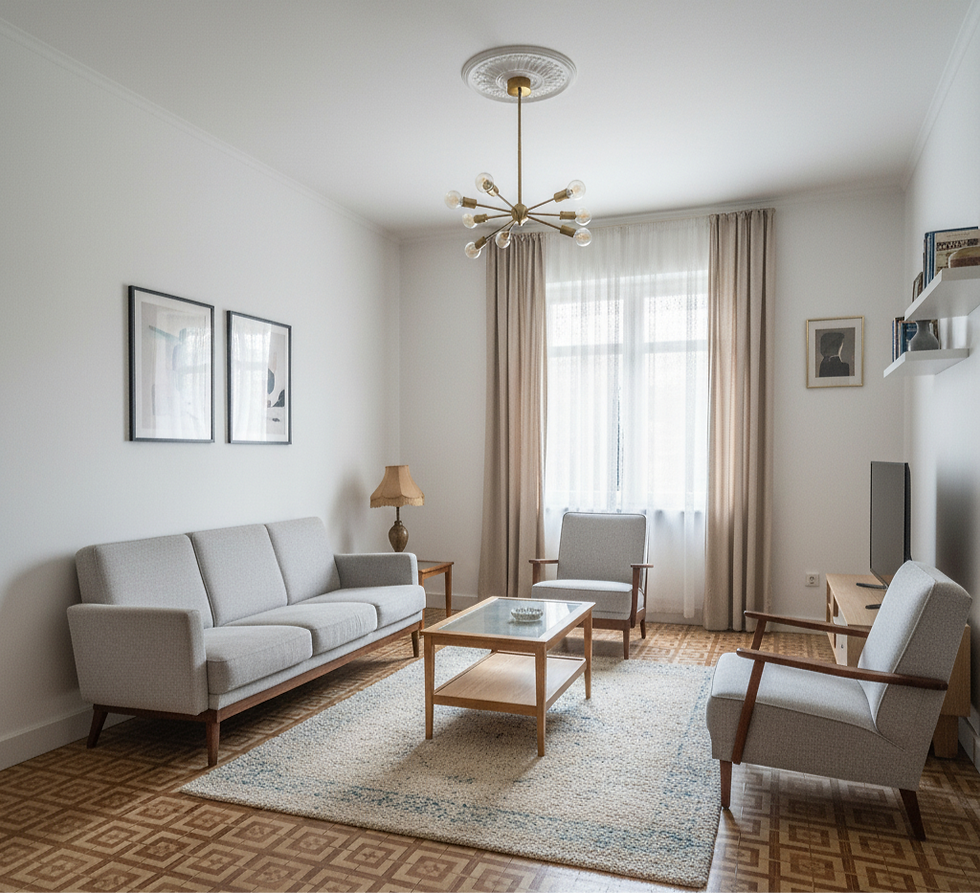
Urban Rehabilitation: Understand the Requirements

The Ordinance No. 304/2019 of September 12 is a key regulatory framework for those wishing to rehabilitate old buildings in Portugal. This legislation sets specific functional requirements tailored to the historical construction context, allowing buildings with construction licenses issued up to January 1, 1977, to be recovered and adapted for contemporary residential use while respecting their original features and enabling the requalification of the national built heritage.

Context and Objective
The Ordinance was issued in compliance with Decree-Law No. 95/2019 of 18 July, which establishes the regime applicable to the rehabilitation of existing buildings or units. Its core objective is to create a flexible and realistic regulatory framework that:
Facilitates the rehabilitation of old buildings without rendering them economically unfeasible
Preserves architectural and heritage features
Ensures minimum living, safety, and hygiene conditions
Promotes urban regeneration and the revitalisation of historic centres
Scope:
Buildings with a construction licence issued up to 1 January 1977
Intended wholly or predominantly for residential use
Subject to rehabilitation operations (alteration, extension, or reconstruction)
Types of Rehabilitation Works
The Ordinance classifies interventions into four categories, each with distinct requirements:
Minor Spatial Reorganisation Works
Alteration works that reorganise internal space within strict limits, meeting all of the following criteria:
No alteration of the location, form, or dimension of more than one third of the compartments
No increase in the number of compartments by more than one
No alteration to the location, form, or dimension of the staircase (if present)
No change to the width of the internal corridor
No change to the number of dwellings
No change to the number of floors
Flexibility: Requirements apply only to the elements directly affected by the intervention.
Major Spatial Reorganisation Works
Alteration works resulting in a significant reorganisation of the dwelling, not included in the previous category.
Requirement: The provisions apply to the entire dwelling under intervention.
Extension Works
Works that increase the building footprint, total construction area, façade height, or volume.
Mixed application:
Pre-existing part: subject to the provisions of Ordinance No. 304/2019 (minor or major reorganisation, as applicable)
Extended part: subject to the General Regulation of Urban Buildings (RGEU)
Reconstruction Works
Construction works following the total or partial demolition of an existing building, resulting in the reinstatement of its façade structure.
Mixed application:
Requirements for Building Interiors
Ceiling Height
Minimum values:
Habitable rooms: 2.30 m
Non-habitable spaces: 2.10 m
Dwellings may maintain an existing height as long as it is not below these minimum values.
Any reduction below the RGEU standard is allowed only if it improves safety, comfort, hygiene, or functionality.
In duly justified exceptional cases, lower existing heights may be maintained (but not further reduced).
Living Room, Bedrooms, and Kitchen
Minimum composition:
One living room
One bathroom
Kitchen facilities (which may be integrated into the living room)
Minor Spatial Reorganisation Works (when affected):
Compartment | Minimum area | Minimum dimension |
Living room | 10 m² (or 14 m² with integrated kitchen) | Circle with diameter ≥ 2.10 m |
Bedroom | 5 m² | Circle with diameter ≥ 2.10 m |
Kitchen | Not specified | Must include sink, cooker, and refrigerator |
Major Spatial Reorganisation Works:
Compartment | Minimum area | Minimum dimension |
Living room | 10 m² (or 14 m² with integrated kitchen) | Circle with diameter ≥ 2.10 m |
Bedroom | 6.5 m² | Circle with diameter ≥ 2.10 m |
Master bedroom (T4 or larger) | 9.0 m² | Circle with diameter ≥ 2.10 m |
Kitchen | Not specified | Must include sink, cooker, and refrigerator |
Note: Where the useful area exceeds 15 m², a circle with a minimum diameter of 2.40 m must fit within the room.
Sanitary Installations
Complete installation: washbasin + toilet + shower tray
Supplementary installation: toilet + washbasin
Minor Spatial Reorganisation:
When intervened, bathrooms must meet at least the requirements of one complete installation; if one already exists, an additional one may be supplementary.
Direct access between a WC and living spaces (except kitchens) is permitted, provided ventilation and hygiene conditions are ensured.
Direct access to kitchens is allowed only if pre-existing and adequately treated.
Major Spatial Reorganisation:
Typology | Required installations |
Less than T3 | 1 complete installation |
T3 or T4 | 1 complete + 1 supplementary |
Above T4 | 2 complete installations |
Corridors and Stairs
Corridors and stairs may retain their dimensions if unaltered.
Altered ones must comply with Article 70 of the RGEU and have a minimum width of 0.70 m.
Openings (Windows and Doors)
General rule: Openings may keep their dimensions. Specific requirements for new or altered compartments:
Directly exterior openings: total area ≥ 1/12 of the room area.
On inclined planes: total area ≥ 1/10 of the room area.
Openings must be located between 0.80 m and 2 m in at least 50% of the required area.
In exceptional cases, natural lighting and ventilation through adjoining rooms are permitted, provided that total opening areas (both exterior and internal) equal at least 1/10 of the total compartment area.
Basements, Attics, and Lofts
At least 50% of the useful floor area must meet the minimum height set in Article 4.
The useful area is the sum of the floor area with a minimum height of 2 m.
Compliance with Articles 77–80 of the RGEU is not required, provided habitability is not reduced.
Shared Areas in Multi-Occupancy Buildings
Vertical Circulation: existing stairs and lifts do not have to meet Articles 46, 47, and 50 of the RGEU but cannot be reduced in size or functionality.
Waste Disposal System: not required to comply with Article 97 of the RGEU.
Yards and Courtyards: not required to comply with Article 76 of the RGEU as long as existing dimensions and functionality are retained.

Integrated Building Regulations
Maximum Building Height:
The minimum distance and height rules under Article 59 of the RGEU need not apply to pre-existing non-conformities, provided they are not worsened.
Exceptions: if subject to specific local regulation, those rules prevail.
Minimum Distance Between Façades:
Existing openings may not comply with Article 60 of the RGEU, provided they remain unaltered.
New or modified openings are allowed only for safety, hygiene, or formal coherence reasons.
Distance Between Rear Façades:
In general, compliance with Article 62 of the RGEU is not required.
If the entire plot layout is reorganised, Article 62 compliance becomes mandatory.
Relationship with the RGEU
The Ordinance No. 304/2019 does not replace the RGEU; rather, it operates subsidiarily:
Advantages and Impact
For owners and developers:
Economic feasibility of rehabilitation projects
Reduction of unnecessary structural costs
Preservation of original architectural identity
Increased property value
For the construction sector:
Stimulus for urban regeneration
Creation of specialist employment
Economic revitalisation of historic centres
Promotion of sustainability (rehabilitation vs. new build)
For society:
Recovery of vacant properties
Revitalisation of urban centres
Preservation of architectural heritage
Enhanced urban living quality
Practical Guidance
Confirm the construction licence date (must be issued before 1 January 1977).
Correctly classify the type of works (minor or major).
Document all pre-existing conditions to justify flexibility requests.
Take local regulations and heritage protection plans into account.
Technically justify design choices in the project’s descriptive report, per Decree-Law No. 95/2019.
Prioritise solutions that improve habitability, even where flexibility is permitted.
Consult experienced architects and engineers to ensure project success.
Final Reflection
Ordinance No. 304/2019 strikes a careful balance between the preservation of built heritage and the need to ensure minimal living standards. By adapting requirements to the reality of older buildings, this regulation enables rehabilitation projects that might otherwise be economically or technically unfeasible, contributing decisively to urban regeneration and the safeguarding of our cities’ architectural identity.